
Personalized Marketing in Modern Times

The apps on your phone probably know your preference better than your friends. Some websites even know how the weather is outside, no matter where you are. The emails that land on your inbox and the social posts you see? All of it is carefully tailored for you.
And this isn’t a coincidence. It’s called personalized marketing and the modern marketing world is perfectly adapting to it.
If you’re a brand or business, bet your modern customers expect you to know what they want. Customers don’t respond to random campaigns anymore. They want brands that pay attention and understand their needs enough to always show up on time.
Today we’ll discuss how modern personalized marketing works, why it drives results, and how organizing customer data helps you provide revenue-driving CX.
What Personalized Marketing Means Today
Back then, adding “Hi {{contact.first_name}}!” in emails used to do the trick. Now it’s much more than just calling you customers by their name.
73% of people expect brands to predict and understand their needs and provide an experience that’s specifically crafted for them.
There’s no “one shoe fits all” anymore. Every time your customer sees your message, they should feel it was meant for them and them only!
A generic marketing copy says: “Here’s our product. Buy it.”
But a personalized marketing copy says: “Hey, I noticed you’ve been checking out our fitness gear. Want to check out the special discount offers?”
Obviously, the second copy feels much more intriguing.
To deliver relevant content, offers, and experiences, you need to use customer data (behavior, preferences, history, demographics) for:
- Product recommendations
- Website content
- Targeted and segmented emails
- Targeted ads
- Email or notification triggers
- Personalized landing pages
- Exclusive offers
Personalized Marketing Ideas (2026 Edition)
Customers are smart and expect you to be smart as well. They want to enjoy fast shopping. It’s convenient if you can give them exactly what they need right when they need them!
We got some practical tips to help.
Personalized product recommendations
A lazy browser may have hovered over a specific product once for a little longer than usual. Or clicked to see the product details. But didn’t proceed to buy it.
Create a personalized recommendation list exclusively for them by tracking the following:
- Browsing behavior
- Purchase history
- Time spent on page
- Items added to cart or wishlist
- Interaction – clicks, swipes, shares, etc.
- Customer segment
- Source
AI product recommendation is almost too perfect these days. So, you can utilize an AI tool for this purpose.
Example:
A person views hiking boots more than once but never buys. On their next visit, make the homepage show “Top Outdoor Gear Picks for You” and maybe with a special discount.
Or show a product table in a custom “Recommended for You” section based on browsing behavior and past purchases.
Recommended For You!
| Product Bundle | Individual Price Total | Bundle Price | You Save | Visit |
|---|---|---|---|---|
| Laptop + Mouse | $1,050 | $950 | $100 | Details... |
| Laptop + Mouse + Keyboard | $1,200 | $1,000 | $200 | Details... |
| Laptop + Mouse + Keyboard + Monitor | $1,800 | $1,100 | $700 (!!!) | Details... |
| Laptop + Full Office Setup (All 4) | $2,200 | $1,200 | $1000 ⭐ | Details... |
| Laptop + Chair + Desk | $1,800 | $1,400 | $400 | Details... |
| Ultimate Productivity Pack (All) | $2,500 | $1,600 | $900 🔥 Best Value! | Details... |
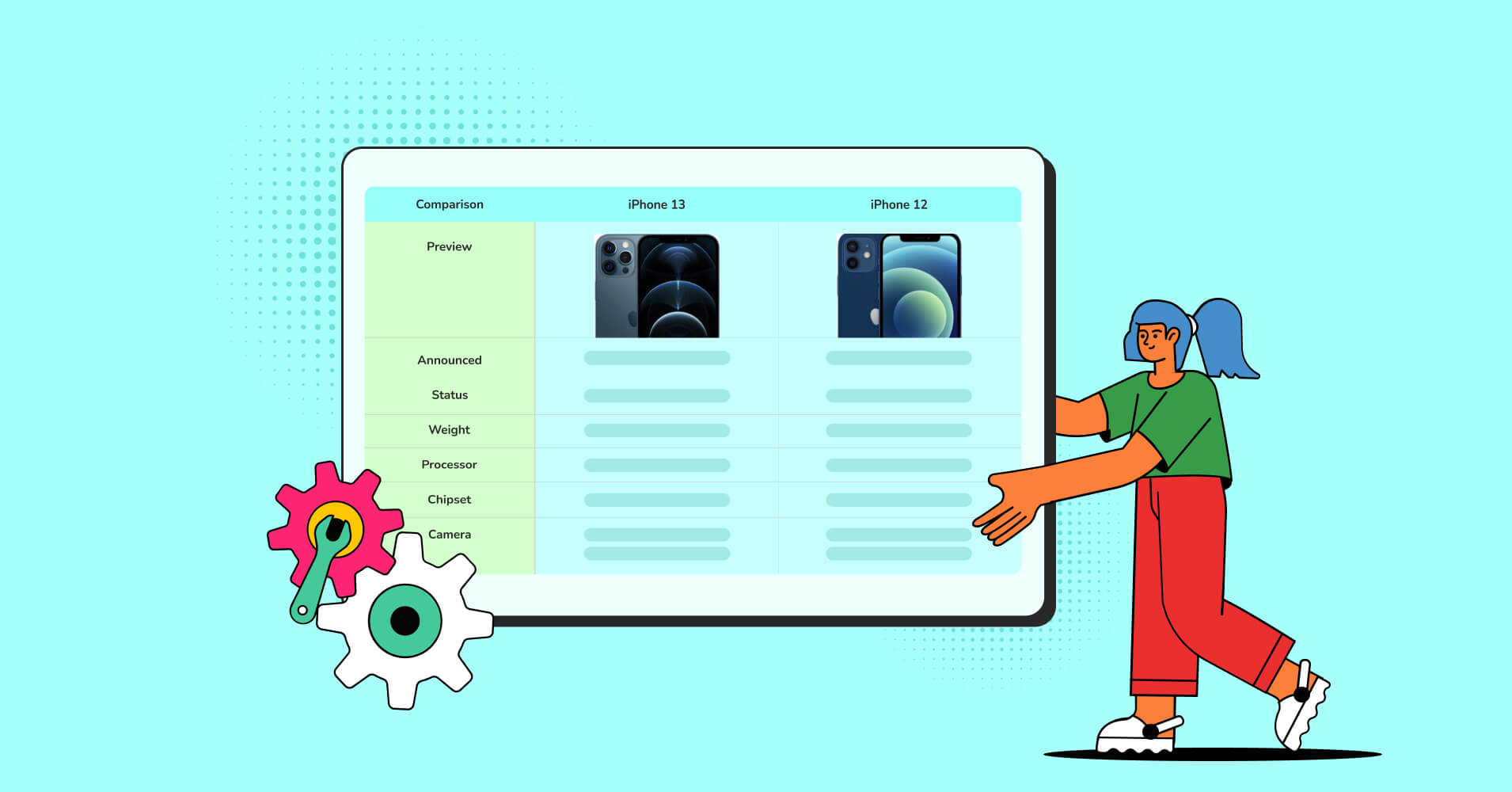
This sort of tables are easy to create with Ninja Tables. Add custom filters, designs, buttons, and as many products you can recommend for your customers.
Display personalized webpage
Show your customers different homepage banners based on their interest.
The top banner, header, headlines, CTAs, recently viewed items – everything can be personalized to target customers’ intent.
You can also choose to display a special offer pricing exclusively to a repeat buyer or a repeat visitor. Label it as a loyalty bonus or gift.
Example:
A visitor once browsed “Home Office” items.
Next time, their homepage should say: “Welcome back! Ready to upgrade your workspace?”
Honestly, the best examples of personalized marketing are YouTube, Facebook, and Netflix. These platforms use algorithms to display a fully personalized page that exactly fits audience preference.
For eCommerce, the more personalized it is, the more AOV it gets.
Segmented email & popups
You can’t treat all your subscribers as equals. Segment the subscribers in different lists depending on their user behaviour, demography, and other preferences. Then tailor the email sequences for each segment.
- Personalized email subject lines
- Purchase-based emails – upsell, reminders, membership, etc.
- Different special offers for each segment
- Geo-targeted emails – recommendations based on local weather
Ninja Tables can keep your audience segment data organized in one place. Filter or apply conditions to find out a customer’s lifetime value, their cart value (total monetary value of items in their carts), average order value, and if they’ve consented to be in your marketing communication channels.
| User ID | Consent | Name | Segment | Last Purchase | LTV | AoV | Last Viewed Category | Cart Value | |
|---|---|---|---|---|---|---|---|---|---|
| u001 | [email protected] | yes | Ethan Reynolds | frequent | 2025-11-20 | 1200 | 85 | fitness | 0 |
| u002 | [email protected] | yes | Park Min Su | abandoned_cart | 0 | 40 | footwear | 65 | |
| u003 | [email protected] | yes | Lina Paul | new | 2025-12-01 | 50 | 50 | home-office | 0 |
| u004 | [email protected] | no | Ariana Mitchell | at_risk | 2025-08-14 | 300 | 60 | electronics | 0 |
| u005 | [email protected] | yes | Jay | vip | 2025-11-30 | 1800 | 120 | fashion | 20 |
| u006 | [email protected] | yes | Hana Chen | frequent | 2025-11-10 | 900 | 75 | beauty | 0 |
| u007 | [email protected] | no | Liam Carter | browser | 0 | 30 | fitness | 0 | |
| u008 | [email protected] | yes | Aiden Rodriguez | abandoned_cart | 0 | 45 | lifestyle | 95 | |
| u009 | [email protected] | yes | Paul | at_risk | 2025-07-22 | 210 | 42 | outdoor | 0 |
| u010 | [email protected] | yes | Elena Brooks | vip | 2025-12-02 | 2500 | 140 | fashion | 35 |
Now, let’s talk “Popups.” These can be very tricky due to their sudden appearance. You can only use them if the transition is smooth and doesn’t feel disruptive.
- Exit intent popups with custom message
- Scroll-depth popup
- Returning visitor popup
- Geo-targeted popup
Behavior-based triggers
Real-time triggers are the most modern aspect of personalization. Any abandoned action by the visitor or something new happening in the store triggers notifications or emails.
- Abandoned cart emails
- Product back-in-stock alert
- Notification to nudge a browser who left
- Price drop notification
- Restoration reminders
- Inactivity trigger to win back
Example:
A user adds headphones to the cart but leaves without purchasing. He receives periodic cart recovery emails customized for him. A reminder after 1 hour of leaving. Then a discount offer after 24 hours. And then after 48 hours, an email describing benefits or use cases with the discount offer or referral bonus offer.
Custom offers
If you can effectively make lists of your visitors and customers based on their purchasing history, browsing behaviour, referral profile, and buying intent, you can provide customized offers.
- Offer discounts based on spending level
- Loyalty bonus
- Interest-based discount offer
- First-time buyer discount
- Seasonal offers
- Referral bonus or gift
| Offer Type | Description | Examples |
|---|---|---|
| Spending Level Discount | Discounts based on total spending or high AOV customers. | “Great! You’ve spent $300 this month — enjoy 15% off your next order!” |
| Loyalty Bonus | Rewards for returning or VIP customers. | “Thanks for being with us for 1 year! We'd like to thank you with a special gift for being a reliable member of our family” |
| Interest-Based Discount | Offers matched to the customer’s browsing categories or interests. | “Looks like you're into home office gear. Would you like a 10% off on ergonomic chairs today?” |
| First-Time Buyer Discount | Special discount given on a customer's first purchase. | “Welcome! Thanks for signing up! Enjoy 20% off on your first order.” |
| Seasonal Offer | Promotions tied to events, holidays or peak seasons. | “Black Friday Sale — up to 50% off selected categories!” |
| Referral Bonus or Gift | Coupons or gifts given when a customer refers a friend. | “Refer a friend and get a $10 gift card when they make their first purchase.” |
Retargeting ads
Paid advertisements are not optional. Thanks to pixel-tracking, you can monitor user behavior to show them the perfect ad that converts.
81% consumers will simply ignore a marketing effort from a brand they have never interacted with.
Remind your actual users about products or categories they viewed through the personalized ads. Show different ads for different stages – viewers, add-to-cart, and checkout abandoners, high-value premium customers, etc.
Zero-party data
This is the most useful way to find what your potential customers need. Zero-party data is when you gather information from your visitors and they give it to you willingly. It’s a form of gamification and invites interactions.
Top successful brands collect zero-party data by:
- Asking visitors to fill up forms or take quizzes – color, size, shipping requirements, etc.
- Showing AI personal shopper that asks the right questions – interest, preference, demography
- Letting people pick categories
- Requesting feedback – “What do you want to see next?”
Here’s how OMY Lab engages their visitors and gets them to take a quiz for their own personal skincare routine.
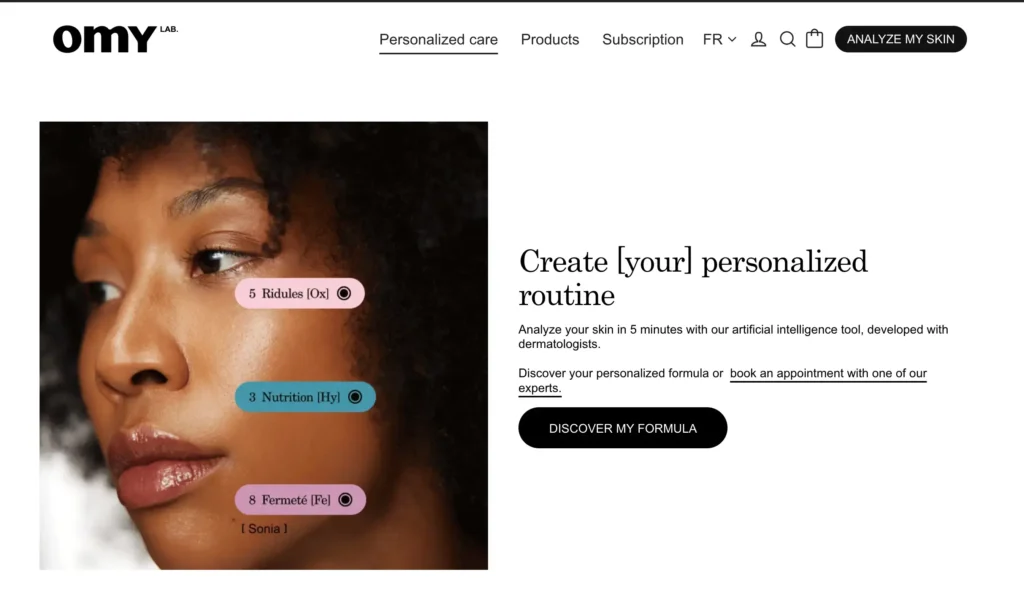
People can analyze their skin right from this website by answering some questions and find the right type of skincare, completely personalized to fit them.
How to Personalize Marketing?
There aren’t many hoops to jump through for the perfect personalization. But you need to take some steps in the correct order.
Everything starts with collecting the right customer data without violating their privacy. Then you organize, identify common patterns, start personlizing each touchpoint, and optimize to track.

Learn personalization step-by-step.
Step 1: Data capture
This is the most crucial step in personalized marketing. You need customer/visitor data but you can’t be invasive. Only capture the data that you need.
- Product interests
- Purchase behaviour and history
- Average order value
- Demography – age, job, orientation, location
- Quiz/survey or form responses
- Time they spend on a page
- Adding a product to cart
- Scroll depth
- Geo-location
- Browsing behaviour
- Email and social interactions
- Referrals and shares
To collect data, you can use popups, customer info tables (Ninja Tables), signup or survey forms (Fluent Forms), UX analytics platforms (Hotjar or MS Clarity), Google Search Console, or Google Analytics.
***Always collect data with consent and provide an easy opt-out option.
Step 2: Organize the captured data
This is the foundation of all personalization. No data is useful if you don’t know how to act on it.
With Ninja Tables, you can:
- Import the messy numeric data into a table format
- Connect your Google Sheets that contains all the data and create a filterable data table
- Fetch all the form entries and create a table to categorize the data
- Track what products are getting more clicks from eCommerce product tables
- Filter, categorize, and format your data table
- Add colors, badges, or conditions
- Create visuals like charts for better view
Once structured in a smart tabular format with data filters, search bars, and indicators like badge/color/conditions, the insights become far clearer.
Step 3: Identify patterns
You must have customers or browsers who appear frequently. Find out the common patterns and ask yourself a few questions.
- Who buys frequently?
- Who hasn’t bought in ‘-number-’ days?
- Which category is the most viewed?
- What product sells the most?
- Who opens emails?
- Who clicks but doesn’t purchase?
- What product has the most back-orders?
- What products are in the most wishlists?
- Who has referred to a friend?
- Who abandoned their carts?
- Who is inactive for too long?
Step 4: Personalized touchpoints
Touchpoints in personalization include your website, the emails and SMS you send, popups, and paid ads.
- Website: Display personalized banners, custom product recommendation tables, dynamic sections based on user behaviour.
- Email: Personalized offers sent to inbox, behavior-based automation, interest-based email sequences. Use FluentCRM for convenience.
- SMS: Order progress alert, reminders, exclusive codes.
- Paid ads: Show ads to custom audiences based on their activity.
- Popups: Different for new visitors, returning visitors, cart abandoners.
Step 5: Measure and optimize
Once you’ve gathered all the necessary data, it’s time to track them right.
Track the following metrics:
- Email open rate
- Click-through-rate (CTR)
- Conversions
- Recovered carts
- Retention rate
- Customer lifetime value (CLV)
You probably won’t get it right in your first try. Don’t worry. Keep calm and keep the data organized to try again.
And at this point, you know where to keep these data filtered and organized.
Why Personalized Marketing Matters for Every Business
If you think you need to be a big fish like Amazon, Netflix, or Spotify to do the perfect and effective personalization, you’re wrong!
You can be a small business or a medium business, and maybe even a solopreneur, personalized marketing is a thing for everyone.
Here are some reasons why.
- People today are impatient. They scroll fast, bounce faster, and prefer brands that just “get them” or they “vibe with.” Hyper-personalization takes care of their needs without asking for much effort from them.
- If you’re not doing it, your competitors are! It’s a brutal market and your message needs to appear in the right place before your competitors.
- From a Google search to purchase and everything in between is data. Track the form submissions, the product carts, the scrolls or clicks, the abandoned carts, the revisits, and recurring purchases.
- The better you target, the higher your conversions are. Incidentally, you get better revenue.
- Your customers will advocate for you if they are happy. Keep up a good customer experience (CX) consistently through personalization.
Since Ninja Tables is suitable for every business, you can organize your customer insights in all kinds of dynamic data tables. Just pick a template you like!
Future of Personalized Marketing
Modern eCommerce or online businesses heavily rely on gaining new customers and making them happy. It’s brutally competitive out there! And personalized marketing isn’t going away anytime soon. In fact, we’ll see more of it in future.
- AI recommendations: We’re in the last half of this current decade. The first half has been all about AI and how to use it for marketing benefits. Brands and businesses, no matter the size, are already using AI to predict customer needs and gather data or customer insights. It will become more and more reliable in the future.
- Zero-party data: Users now willingly share their demography and preferences to enjoy a personalized experience. It will be more regulated, secure, and necessary soon.
- Trust and transparency: People are becoming more conscious about their data privacy. Responsible, transparent, and secure personalization is only a matter of time.
Some Common Challenges to Overcome
There’s no magic dust you can scatter and get effective personalization done. It’s not simply collecting first names, sending a Hi {first_name}, and praying they convert!
You need to recognize the challenges before taking any step.
- Avoid over-personalization, being creepy, and invasive. You’re supposed to collect data and personalize to help customers, not stalk them.
- Focus on the right data and data quality. Traffic is only valuable if you know which source converts.
- Don’t overwhelm your audience with custom messages or notifications. Pick the right time and content.
- Segment carefully and keep track.
- Your data probably sits in random spreadsheets, CRMs, forms, platforms. Keep information from multiple touchpoints (purchases, analytics, email metrics, leads, ad insights) organized using Ninja Tables.
- You don’t map your customers’ journey and don’t have an unified system.
- Cookie consent, GDPR, data security.
- Don’t underestimate the importance of AI in personalization.
Wrap Up
Marketing personalization isn’t easy. It’s data-driven, organized, and intentional.
When done right, personalization builds trust. It helps your customers feel seen, understood, and valued – not just targeted.
Modern personalized marketing goes beyond addressing customers with their first name. Start by organizing customer data. Learn their patterns. Show up at the right moment. Use AI and personalization tools.
Customers love a brand that truly “gets” them. Earn their loyalty through personalization and keep them coming back.

Ninja Tables– Easiest Table Plugin in WordPress
FAQs
What is meant by personalized marketing?
Personalized marketing is when customers get a tailored and customized message that speaks directly to them. It’s a strategy to ensure maximum comfort for customers and better conversion. Businesses can create personalized and relevant content for customers by analyzing their persona, past interactions, and preferences.
What is an example of personalized marketing?
An example of personalized marketing would be Netflix. This streaming platform uses algorithm and your own watch history to recommend shows.
What is zero-party data?
Zero-party data is the information customers share with a brand willingly and voluntarily. This happens through surveys, forms, social comments, or chatbots where they share their likes/dislikes, interests, and other personal details.
Am I doing personalization wrong?
If you’re manipulating customers, violating their privacy, or being intrusive in gathering customer data, you are doing personalization wrong.


Add your first comment to this post